Grand Hotel
圓山大飯店· Architecture
About
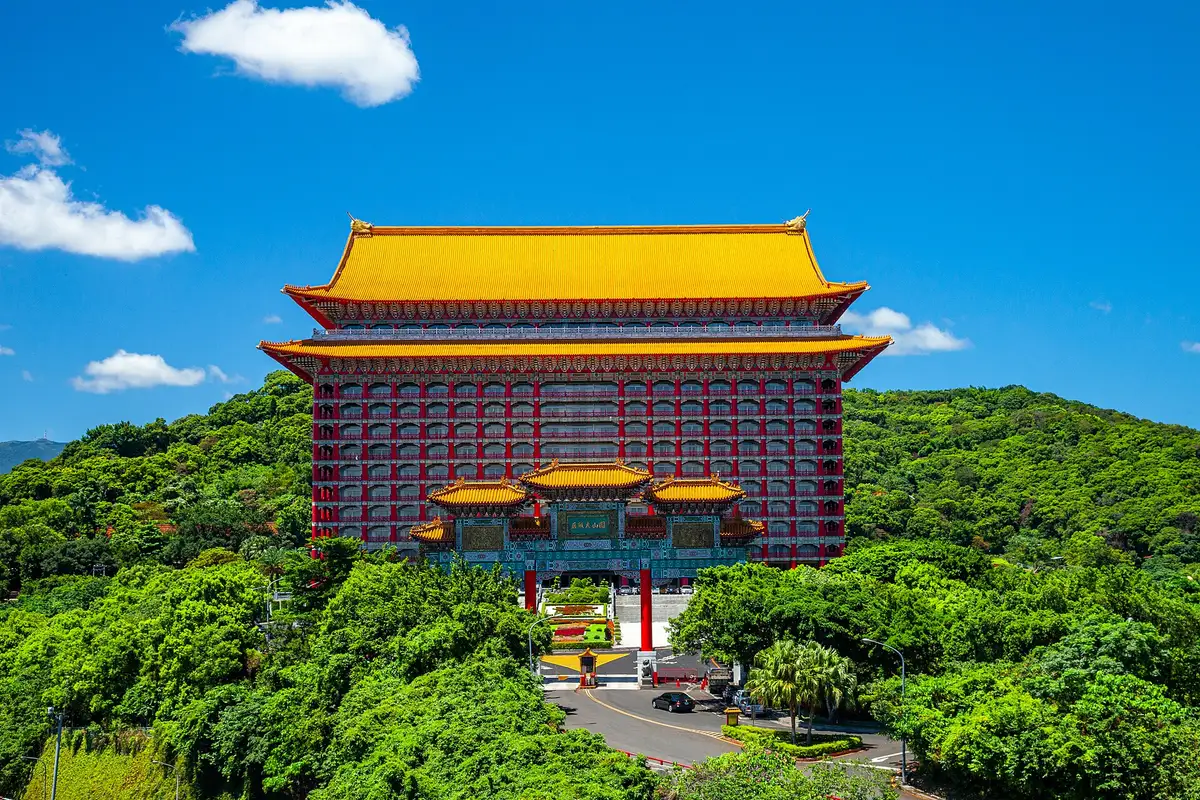
Founded in 1952, the 14-storey palace-style hotel stands on the slopes of Yuanshan with red columns and golden tiles. Its Golden Dragon Restaurant keeps a bronze dragon from the former Taiwan Shrine, gilded in 1987, and the lobby ceiling has a plum-blossom caisson with five golden dragons.
Full description, from the tourism database
Founded in 1952, the Grand Hotel is a 14-storey palace-style building on the slopes of Yuanshan, with the Keelung River in front, Yangmingshan behind, Songshan to the east and Tamsui to the west. Its red columns and golden tiles give it a classical Chinese look, and it is one of Taipei's landmarks. The hotel has a long history and legends of secret passages. The century-old Golden Dragon was originally a bronze dragon in front of the Taiwan Shrine. It was kept intact when the hotel added new halls and is now displayed in the Golden Dragon Restaurant. During renovation in 1987 it was plated in 24-carat gold. Unusually, this coiled dragon has only three claws, unlike the four or five claws of traditional Chinese dragons. At the centre of the lobby ceiling is a plum-blossom caisson, where five golden dragons circle a dragon pearl, meaning 'five blessings arrive at the door'. Around it are 23 golden dragons and 16 phoenixes, and the caisson as a whole symbolises the auspicious pairing of dragon and phoenix. The upturned eaves and dougong brackets of the roof reflect ancient Chinese building tradition. A row of crouching beast figures sits on the hip ridges above the eaves, and chiwei, ceramic beast-shaped ornaments, are placed between the main ridge and the hip ridges. Below the roof is an ornate but sturdy dougong bracket structure. The large floor-to-ceiling glass doors at the main entrance look plain and formal, but the patterns on them conceal six ancient characters reading 'Long live the Republic of China', reflecting the period when the hotel was rebuilt and the designer's ingenuity. The shigandang stone at the steps in front of the archway bears four characters in cursive script by Yu Youren, 'Jiantan Shengji' (Scenic Site of Jiantan). According to various sources, the words express the idea that all of Yuanshan is a sacred place.
Translated and shortened by DealTaipei from Taiwan's national tourism database. Sources are on the terms page.
Facts and sources
- Names
- EN Grand Hotel中文 圓山大飯店한국어 위안산 대반점日本語 円山大飯店 Wikidata Q712865, Chinese from the listing, Korean by DealTaipei (NIKL transcription)
- District
- Zhongshan District · 中山區 Tourism Administration listing, updated 2026-05-22
- Opening hours
- Not in the listing: see the official site Tourism Administration listing, read 2026-09-30
- Phone
- (02)28868888 Tourism Administration listing. May be Chinese only
- Official site
- grand-hotel.orgWikidata
- Data
- /api/sight/grand-hotel.json The same facts as JSON, for apps and AI agents
Getting there





 National Revolutionary Martyrs' Shrine Museum · 689 m away
 Wikidata (CC0). Sources and photo credits are on the terms page.