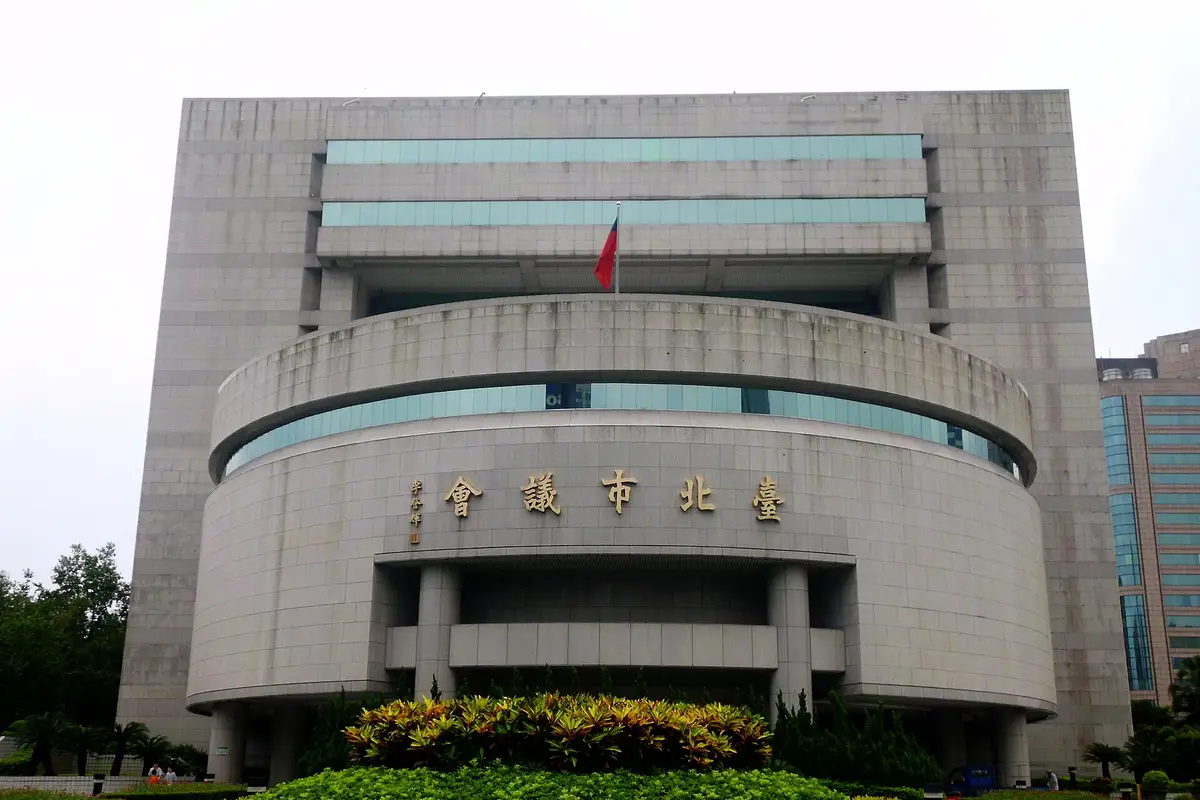
Taipei City Council
臺北市議會· Architecture
About
In the early years after Taiwan's retrocession, to lay the foundations for local self-government, the Taiwan Provincial Administrative Executive Office announced a plan on 26 December 1945 for setting up representative bodies at every level in Taiwan Province. Under the Nationalist Government's regulations on the organisation of municipal consultative councils and the election of councillors, the Taipei City Consultative Council was set up on 15 April 1946.
Read more
Although it was a representative body, at the time it was only advisory. After the Nationalist Government moved to Taiwan on 7 December 1949, local self-government did not operate under the constitutional system. Instead, an outline for implementing local self-government in the counties and cities of Taiwan Province was issued on 24 April 1950 as the basis for local self-government in Taiwan, and the body became the council of a provincial city. On 1 July 1967 Taipei was upgraded from a provincial city to a special municipality. Until the first special-municipality council was formed (on 25 December 1969), a Taipei City Provisional Council exercised its powers during the transition. The laws on special-municipality self-government were still incomplete, so an administrative order served as the legal basis: an outline on the organisation of Taipei City at all levels and the implementation of local self-government, issued by the Executive Yuan on 22 June 1967. Only after the Self-Governance Act for Special Municipalities took effect on 29 July 1994 were the council's legislative powers and its oversight of finance and administration guaranteed by law, putting into practice Article 118 of the Constitution, which states that the self-government of special municipalities shall be regulated by law. In response to the trend of dividing power between central and local government, the Local Government Act, promulgated on 25 January 1999, merged the separate rules for special municipalities and for provinces, counties and cities into one, opening a new chapter in the history of local self-government in Taiwan. The council is the city's local legislature and oversees the city government on behalf of its citizens. Its legislative powers are exercised by councillors from each district, who represent a diverse society. Through proposals, discussion, debate and negotiation, and following the democratic principle of majority rule with respect for the minority, diverse public opinion is turned into policies and laws for all citizens to follow, protecting residents' rights. Through legislative oversight, the council aims to push the city government to do good and root out abuses, improve citizens' welfare and quality of life, and so fulfil its duty as a local legislature.
Translated and shortened by DealTaipei from Taiwan's national tourism database. Sources are on the terms page.
Facts and sources
- Names
- EN Taipei City Council中文 臺北市議會한국어 타이베이 시의회日本語 台北市議会 Wikidata Q7676278, Chinese from the listing, Korean by DealTaipei (NIKL transcription)
- District
- Xinyi District · 信義區 Tourism Administration listing, updated 2026-06-22
- Opening hours
- Not in the listing: see the official site Tourism Administration listing, read 2026-09-30
- Phone
- (02)27297708 Tourism Administration listing. May be Chinese only
- Official site
- tcc.gov.twWikidata
- Data
- /api/sight/taipei-city-council.json The same facts as JSON, for apps and AI agents
Getting there


 National Dr. Sun Yat-sen Memorial Hall Architecture · 273 m away Rainbow Starting Line Public art · 151 m away Xiangdi Avenue Plaza Park and garden · 514 m away Xinyi Planning District Shopping street · 523 m away


 Taipei Dome Theatre and venue · 538 m away
 Wikidata (CC0). Sources and photo credits are on the terms page.